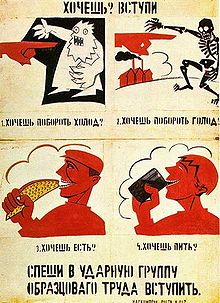
-Synchromism was an art movement founded in 1912 by American artists Stanton MacDonald-Wright and Morgan Russell
-Their abstract "synchromies", based on a theory of color that analogized it to music, were among the first abstract paintings in American art.
-Synchromism became the first American avant-garde art movement to receive international attention.
-Synchromism is based on the idea that color and sound are similar phenomena, and that the colors in a painting can be orchestrated in the same harmonious way that a composer arranges notes in a symphony.
-The abstract "synchromies" are based on color scales, using rhythmic color forms with advancing and reducing hues.
-The earliest synchromist works were similar to Fauvist paintings.
-Synchromism was developed by Stanton MacDonald-Wright and Morgan Russell while they were studying in Paris during the early 1910s
-From 1911 to 1913, they studied under the Canadian painter Percyval Tudor-Hart, whose color theory connected qualities of color to qualities of music, such as tone to hue and intensity to saturation
-The first synchromist painting, Russell's Synchromy in Green, exhibited at the Paris Salon des Indépendants in 1913.
- Synchromism remained influential well into the 1920s.
Morgan Russell
Stanton MacDonald-Wright
-Der Blaue Reiter (The Blue Rider) was a group of artists from the Neue Künstlervereinigung München in Munich, Germany.
-The group was founded by a number of Russian emigrants, including Wassily Kandinsky, Alexej von Jawlensky, Marianne von Werefkin, and native German artists, such as Franz Marc, August Macke and Gabriele Münter.
- Der Blaue Reiter was a movement lasting from 1911 to 1914, fundamental to Expressionism, along with Die Brücke which was founded in 1905.
-The name of the movement is the title of a painting that Kandinsky created in 1903, but it is unclear whether it is the origin of the name of the movement, as Professor Klaus Lankheit learned that the title of the painting had been overwritten.
-Kandinsky wrote 20 year later that the name is derived from Marc's enthusiasm for horses and Kandinsky's love of riders, combined with both love of the color blue.
-Within the group, artistic approaches and aims varied from artist to artist; however, the artists shared a common desire to express spiritual truths through their art.
-They believed in the promotion of modern art; the connection between visual art and music; the spiritual and symbolic associations of colour; and a spontaneous, intuitive approach to painting.
-The group was disrupted by the outbreak of the First World War in 1914. Franz Marc and August Macke were killed in combat. Wassily Kandinsky, Marianne von Werefkin and Alexej von Jawlensky were forced to move back to Russia because of their Russian citizenship.
- There were also differences in opinion within the group. As a result, Der Blaue Reiter was short-lived, lasting for only three years from 1911 to 1914.
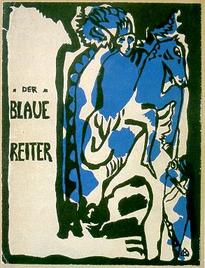
Wassily Kandinsky
-The Section d'Or ("Golden Section"), also known as Groupe de Puteaux or Puteaux Group, was a collective of painters, sculptors and critics associated with Cubism and Orphism.
- Based in the Parisian suburbs of Puteaux and Courbevoie, the group was active from 1911 to around 1914, coming to prominence in the wake of their controversial showing at the Salon des Indépendants in the spring of 1911.
-The group seems to have adopted the name Section d'Or to distinguish themselves from the narrower definition of Cubism developed in parallel by Pablo Picasso and Georges Braque in the Montmartre quarter of Paris, and to show that Cubism, rather than being an isolated art-form, represented the continuation of a grand tradition (indeed, the golden ratio had fascinated Western intellectuals of diverse interests for at least 2,400 years).
-The Puteaux Group (an offshoot of la Société Normande de Peinture Moderne) organized their first exhibition under the name Salon de la Section d'Or at the Galerie La Boétie in Paris, October 1912. Albert Gleizes and Jean Metzinger, in preparation for the Salon de la Section d'Or, published a major defence of Cubism, resulting in the first theoretical essay on the new movement, entitled Du "Cubisme" (published by Eugène Figuière in 1912, translated to English and Russian in 1913).
-The 1912 Salon de la Section d'Or was arguably the most important pre-World War I Cubist exhibition.
-The idea of the Section d'Or originated in the course of conversations between Gleizes, Metzinger and Jacques Villon.
-Peladan attached great mystical significance to the golden section (French: Section d'Or), and other similar geometric configurations.
-After World War I, with the support given by the dealer Léonce Rosenberg, Cubism returned as a central issue for artists.
-With the Salons dominated by a return to classicism, Albert Gleizes attempted to resuscitate the spirit of the Section d'Or in 1920 but was met with great difficulty, despite support by Fernand Léger, Alexander Archipenko, Georges Braque and Léopold Survage.
Albert Gleizes
Jean Metzinger
Marcel Duchamp
Futurism was an artistic and social movement that originated in Italy in the early 20th century.
-It emphasized and glorified themes associated with contemporary concepts of the future, including speed, technology, youth and violence, and objects such as the car, the airplane and the industrial city. It was largely an Italian phenomenon, though there were parallel movements in Russia, England and elsewhere.
-The Futurists practiced in every medium of art, including painting, sculpture, ceramics, graphic design, industrial design, interior design, theatre, film, fashion, textiles, literature, music, architecture and even gastronomy.
-The founder of Futurism and its most influential personality was the Italian writer Filippo Tommaso Marinetti
-Marinetti launched the movement in his Futurist Manifesto, which he published for the first time on 5 February 1909 in La gazzetta dell'Emilia, an article then reproduced in the French daily newspaper Le Figaro on 20 February 1909. He was soon joined by the painters Umberto Boccioni, Carlo Carrà, Giacomo Balla, Gino Severini and the composer Luigi Russolo.
-The Futurist painters were slow to develop a distinctive style and subject matter. In 1910 and 1911 they used the techniques of Divisionism, breaking light and color down into a field of stippled dots and stripes, which had been originally created by Giovanni Segantini and others.
-The Futurist architect Antonio Sant'Elia expressed his ideas of modernity in his drawings for La Città Nuova (The New City) (1912–1914). This project was never built and Sant'Elia was killed in the First World War, but his ideas influenced later generations of architects and artists.
- This project was never built and Sant'Elia was killed in the First World War, but his ideas influenced later generations of architects and artists.
-Russian Futurism was a movement of literature and the visual arts. The poet Vladimir Mayakovsky was a prominent member of the movement. Visual artists such as David Burlyuk, Mikhail Larionov, Natalia Goncharova and Kazimir Malevich found inspiration in the imagery of Futurist writings and were poets themselves.
-Futurist music rejected tradition and introduced experimental sounds inspired by machinery, and would influence several 20th century composers.
-Futurism as a literary movement made its official debut with F.T. Marinetti's Manifesto of Futurism (1909), as it delineated the various ideals Futurist poetry should strive for.
Giacomo Balla
Umberto Boccioni
An example of futurustic architecture:
-Constructivism was an artistic and architectural philosophy that originated in Russia beginning in 1919, which was a rejection of the idea of autonomous art.
-The movement was in favour of art as a practice for social purposes.
- Constructivism had a great effect on modern art movements of the 20th century, influencing major trends such as Bauhaus and the De Stijl movement
-Its influence was pervasive, with major impacts upon architecture, graphic and industrial design, theatre, film, dance, fashion and to some extent music.
-The term Construction Art was first used as a derisive term by Kazimir Malevich to describe the work of Alexander Rodchenko in 1917.
-Constructivism as theory and practice was derived largely from a series of debates at INKhUK (Institute of Artistic Culture) in Moscow, from 1920–22.
-As much as involving itself in designs for industry, the Constructivists worked on public festivals and street designs for the post-October revolution Bolshevik government.
-Cubism is an early 20th century avant-garde art movement pioneered by Pablo Picasso and George Braque that revolutionized European painting and sculpture, and inspired related movements in music,
-Cubism has been considered the most influential art movement of the 20th-century.
- A primary influence that led to Cubism stems from the representation of three-dimensional form produced during the late 1900s by Paul Cézanne, following a retrospective at the 1907 Salon d’Automne
-In Cubist artworks, objects are analyzed, broken up and re-assembled in an abstracted form—instead of depicting objects from one viewpoint, the artist depicts the subject from a multitude of viewpoints to represent the subject in a greater context.
-The beginnings of Cubism have been dated between 1907 and 1911.
-The first organized group exhibition by Cubists took place at the Salon des Indépendants in Paris during the spring of 1911 in a room called ‘Salle 41’; it included works by Jean Metzinger, Albert Gleizes, Fernand Léger, Robert Delaunay and Henri Le Fauconnier, yet no works by Picasso and Braque were exhibited.
-During the late 19th and early 20th centuries, the European cultural elite were discovering African, Micronesian and Native American art for the first time. Artists such as Paul Gauguin, Henri Matisse, and Pablo Picasso were intrigued and inspired by the stark power and simplicity of styles of those foreign cultures.
Paul Cezanne
Pablo Picasso
Geoerges Braque
-Die Brücke (The Bridge) was a group of German expressionist artists formed in Dresden in 1905, after which the Brücke Museum in Berlin was named.
-Founding members were Fritz Bleyl, Erich Heckel, Ernst Ludwig Kirchner and Karl Schmidt-Rottluff. Later members were Emil Nolde, Max Pechstein and Otto Mueller. The seminal group had a major impact on the evolution of modern art in the 20th century and the creation of expressionism
-The founding members of Die Brücke in 1905 were four Jugendstil architecture students: Fritz Bleyl (1880–1966), Erich Heckel (1883–1970), Ernst Ludwig Kirchner (1880–1938) and Karl Schmidt-Rottluff (1884–1976).
-Die Brücke aimed to eschew the prevalent traditional academic style and find a new mode of artistic expression, which would form a bridge (hence the name) between the past and the present
The group members initially "isolated" themselves in a working-class neighborhood of Dresden, aiming thereby to reject their own bourgeois backgrounds.
-The group published a broadside called Programme in 1906, where Kirchner wrote:
We call all young people together, and as young people, who carry the future in us, we want to wrest freedom for our actions and our lives from the older, comfortably established forces
Some samples are: